There is a strange contradiction happening in the AI industry. The cost of using individual AI models has generally been falling, with newer models often offering more capability for less money than their predecessors. Yet many companies are discovering that their overall AI spending is going in the opposite direction.
That may sound like a pricing problem, but it often is not. The more complicated explanation is that cheaper tokens encourage people and software systems to use more of them, while newer AI applications are also making significantly more requests than traditional chatbots did. As a result, the price of each token can fall while the total number of tokens being consumed rises much faster.
Cheaper Tokens Do Not Automatically Mean Cheaper AI
Imagine that an AI provider cuts its price per million tokens in half. If your application continues using exactly the same amount of tokens, your bill should fall by roughly the same proportion.
The problem is that applications rarely stay exactly the same. Developers add longer prompts, more conversation history, larger documents, tool calls, automated workflows, and increasingly sophisticated AI agents. Each of those changes can increase the amount of information being processed, sometimes dramatically.
This means there are really two different numbers to pay attention to: the price of each token and the number of tokens you consume. Looking at only one of them can give you a very misleading picture of how much your AI system actually costs.
The Token Bill Is Becoming a Real Business Problem
The industry is already starting to see the consequences. In a June 2026 report, TechCrunch described companies struggling with rapidly increasing AI bills despite falling per-token prices. Some businesses had already exceeded annual AI budgets months into the year, while others were introducing new controls to understand and limit token consumption. TechCrunch's report on the industry's growing AI token costs
The underlying problem is relatively simple. AI adoption is increasing faster than many companies expected, and modern AI applications can consume vastly more tokens than the simple chatbot interactions that originally shaped people's understanding of AI costs.
A developer asking a model one question at a time is one thing. An AI agent that reasons through a task, calls several tools, reads documents, writes intermediate responses, checks its own work, and then tries again is something entirely different.
The model may be cheaper than it was a year ago, but the workload is no longer the same.
Agents Changed the Economics
This is where AI agents have made the problem considerably more complicated.
A traditional chatbot might receive one prompt and generate one response. An agent, by comparison, can perform a sequence of actions before completing a task. It may read a file, search for information, call an API, analyze the result, generate another request, and then repeat the process several times.
Every one of those steps can consume tokens. The important point is that an agent does not necessarily become expensive because any individual request is expensive. It can become expensive because a single user instruction generates dozens of model interactions behind the scenes. This creates a completely different relationship between users and token consumption. A person may think they have asked the AI one question, while the underlying application has effectively asked the model twenty questions.
More Capable AI Can Mean More Usage
There is also a psychological side to the problem. When AI becomes cheaper and more capable, people naturally find more ways to use it.
A developer who once used AI for a few coding questions per day may eventually have an AI agent working continuously inside their development environment. A company that previously used a chatbot for customer support might begin using AI to classify tickets, summarize conversations, search internal documentation, draft responses, review those responses, and update other systems.
Each individual feature can look inexpensive. Collectively, however, they can create a substantial amount of token consumption. This is one reason AI economics can be counterintuitive. Improvements in efficiency do not necessarily reduce total spending if they make it economical to use AI in many more places.
The same phenomenon has happened in other areas of technology. When computing becomes cheaper, companies generally do not spend less on computing forever; instead, they find more things to compute.
AI appears to be following a similar pattern.
The Number You Should Actually Be Watching
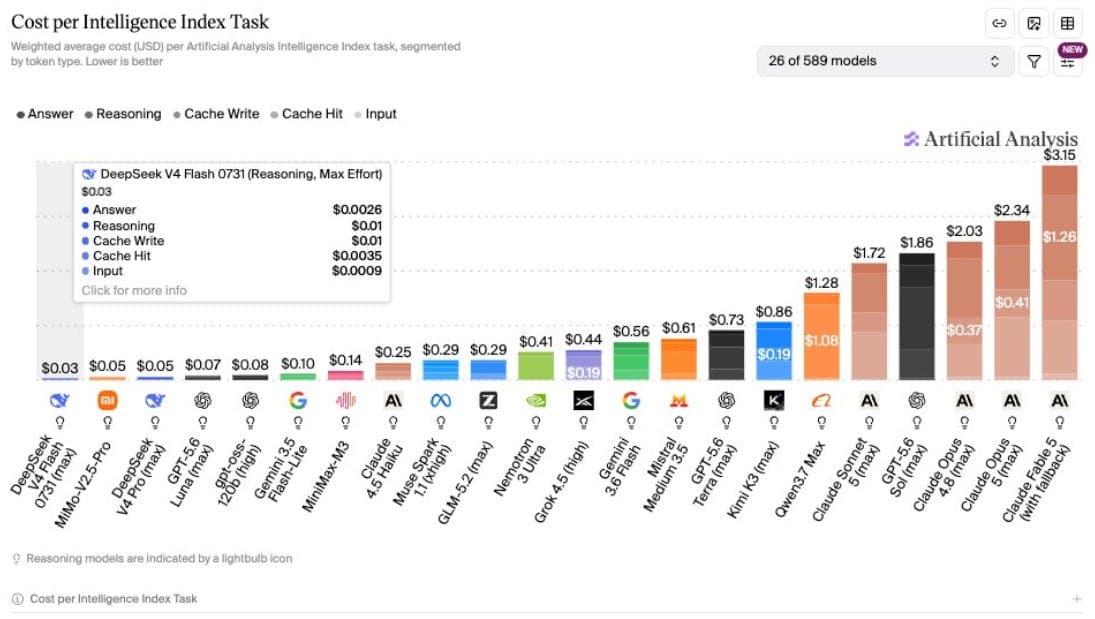
If you are trying to understand whether an AI application is becoming more efficient, the price per million tokens is only part of the story. You also need to know how many tokens are being consumed to accomplish a particular task. A model that costs twice as much per token could still be cheaper overall if it completes the task using a fraction of the tokens.
Conversely, a very inexpensive model can become surprisingly expensive if an application repeatedly sends huge prompts or requires many attempts before completing a task. This is why measuring cost per task can be more useful than looking at model pricing in isolation. Instead of asking how much a model costs per million tokens, ask how much it costs to produce one useful result.
That could mean one completed customer-support ticket, one piece of generated code, one analyzed document, or one successfully completed agent workflow.
Token Efficiency Matters More Than Token Price
This distinction also changes the way developers should think about optimization. Reducing the price of a model is useful, but it is not the only way to reduce costs. You can also reduce the number of tokens required to accomplish the same task.
That might involve shortening system prompts, removing unnecessary conversation history, retrieving only relevant sections of documents, choosing a smaller model for simple requests, or reducing the number of times an agent calls the model.
The best result often comes from combining several of these approaches rather than relying on a single optimization.
You can use the Prompt Toolbox Tokens per Dollar tool to compare token consumption against the money you are spending and get a clearer picture of how much value you are actually getting from your AI usage.
A Cheap Model Can Still Become an Expensive System
This is perhaps the easiest mistake to make when evaluating an AI application: a developer sees that a model costs only a few dollars per million tokens and assumes that the application will therefore be inexpensive to operate. But the model price is only one part of the equation.
If the application processes millions of tokens every day, repeatedly sends the same large instructions, maintains enormous conversation histories, or runs autonomous agents that make dozens of calls for every task, the total bill can become substantial even when the underlying model is relatively cheap.
The opposite can also be true. A more expensive model may complete a complicated task in fewer steps, require fewer corrections, and produce a useful result more consistently. In that situation, the higher token price may actually produce a lower cost per successful outcome.
This is why optimizing AI costs requires looking beyond the model's advertised price.
The AI Industry Is Moving From Model Economics to Usage Economics
As AI becomes embedded in software, the question companies ask is gradually changing… It used to be enough to ask which model was the most capable or which provider offered the lowest price. Increasingly, companies need to understand what happens after a model is deployed: how many tokens are being consumed, which features generate the most usage, which workflows are inefficient, and whether that spending is producing enough value to justify itself.
This is particularly important as AI agents become more common. The amount of work performed by an AI system can grow much faster than the number of visible interactions users have with it.
The result is an AI economy where the cost of the individual token matters, but the behavior of the system matters even more.
Cheaper AI Does Not Mean Free AI
AI models are becoming more capable and, in many cases, less expensive to use. That is genuinely good news for developers and consumers, but it does not guarantee lower AI bills.
If cheaper models lead to dramatically higher usage, the savings can disappear quickly. A system that consumes ten times as many tokens at half the price per token is not actually cheaper.
The important number is therefore not simply how much a token costs. It is how many tokens you need to accomplish something useful, how often your system consumes them, and whether the resulting output creates enough value to justify the expense; AI may be getting cheaper… But if you keep giving it more work, your bill does not have to follow.